Plumber websites
Plumber Website Design for Local Plumbing Companies
You fix drains, water heaters, and leaks. Your website should show homeowners what you fix, which towns you drive to, and how to reach you in one tap, with no agency fluff and no per-lead fees.
What you get
Built for how homeowners look for a plumber
Crawlable WordPress pages
Real text on every page, so Google and AI search tools can read what you do.
A page for each plumbing job
Drain cleaning, water heaters, tankless, sewer, leaks, and repiping, each on its own page.
Built for phones first
Many people looking for a plumber are on a phone, often with water on the floor.
Real service-area pages
Pages for the towns you actually cover, written about each town.
Your number, one tap away
Your own phone number with tap-to-call on every page, plus a short quote form.
Maintenance and unlimited updates
$49/mo keeps the site current after launch as your services and towns change.
You do the plumbing. We build the website.
What homeowners check
What homeowners check before they call a plumber
A homeowner with a backed-up drain or a cold shower does not read your whole website. They give it a few seconds on a phone, and in that time they are looking for four things: do you fix this problem, do you come to my town, can I reach you right now, and do you look like a real, local business.
That is why every plumbing site we build puts the answers up front. The first screen names the problems you fix in the words homeowners use (“clogged drain,” “no hot water,” “leak under the sink”), lists your service area, and shows a big button to call you. Service pages and town pages then go deeper for the people who are comparing two or three plumbers before booking.
Trust details matter more in plumbing than in most trades, because you are going inside someone’s home. Your build has room for your license number if your state requires one, your years in business, photos of your own trucks and crew, and real reviews you already have on Google. We never write fake reviews or invent credentials. If you do not have something yet, the page simply leaves it out.
Service pages
Service pages built around real plumbing jobs
One page per job is how a plumbing site gets found for more than its own name. Each page is written about that job and your shop, not a generic paragraph with the service name swapped in.
Drain cleaning and hydro jetting
One of the most common plumbing calls. The page explains kitchen, bathroom, and main line clogs, when you snake and when you jet, and what a homeowner should do while they wait for you.
Water heater repair and replacement
Covers no hot water, leaking tanks, pilot problems, and replacement. Room to name the brands you install and how you handle haul-away.
Tankless water heaters
Tankless buyers research more and call later. A separate page lets you explain sizing, gas versus electric, flushing, and repair without crowding the tank page.
Sewer line repair and camera inspection
Explains what a camera inspection shows, signs of a broken or root-filled line, and the repair options you actually offer, such as spot repair, replacement, or trenchless work.
Leak detection, slab leaks, and repiping
For the homeowner with a damp wall, a hot spot on the floor, or a high water bill. Repiping gets its own page if it is a job you want more of.
Emergency plumbing
If you take night and weekend calls, this page says so in plain words and puts your number at the top. If you do not, we leave it off so nobody calls at 2 a.m. expecting you.
Gas lines, fixtures, garbage disposals, sump pumps, water softeners, backflow testing, and commercial work can each get a page on the larger plans. Our plumber website cost guide shows how page count changes the price.
Two kinds of customers
Emergency calls and planned installs need different pages
The emergency caller
Water is coming through the ceiling or the toilet will not stop running. This person wants a phone number, a sign that you are open, and proof you serve their town. Emergency pages stay short, put your tap-to-call button at the top and again halfway down, and skip anything that slows the page down on a weak cell signal.
The planned buyer
Someone replacing a 15-year-old water heater, going tankless, or repiping an older house will compare a few plumbers over several days. They read more. Their pages explain options, what affects the price, how long the job takes, and what to expect on install day, with a quote form for people who would rather type than call.
Drain cleaning and rooter companies
Many drain and sewer shops get most of their work from a handful of jobs: clogged lines, main line backups, hydro jetting, and camera inspections. You do not need a giant site to cover that well. A Starter site with strong drain, jetting, and camera pages, plus one or two town pages, is often enough to start, and the ~50-page site adds room for every town you drive to.
If you are paying a lead company for rooter jobs today, your own pages are how you start getting some of those calls directly. Our guide to what plumbing leads really cost walks through the math.
Service areas
Town pages that are not copy-paste
Plumbing is local. Homeowners search for “plumber in” plus their town, and Google wants to see that a business really serves that place. The lazy way to do this is twenty copies of one page with only the city name changed. Search engines treat those as doorway pages, and homeowners can tell.
Our town pages are written about the town: the kind of housing you see there (older homes with cast iron drains, newer tracts with tankless units, slab foundations), the problems that come up most, the neighborhoods you cover, and the services you offer in that area. If you only cover three towns, you get three good pages, not thirty thin ones.
Your business name, address, and phone number are written the same way on every page and in your structured data, so search engines are not confused by small differences. That consistency matters most when it also matches your Google Business Profile. If you want help there too, see Google Business Profile management.
Calls and quotes
How homeowners reach you: call or quote form
The point of a plumber website is to make your phone ring with real local jobs. So every site we build shows your own phone number in the header of every page, set up so a homeowner can tap it to call from a phone. On a desktop, the number is easy to read and copy.
Not everyone wants to call. Some people are at work, some want a price on a planned job first. A short quote form (name, phone, town, and what is going on) catches those people instead of losing them to the next plumber. Each request lands in your email so you can call them back.
We keep forms short on purpose. Every extra box is a reason to give up on a phone.
Included on every plan
Search and AI basics on every plumbing site
More homeowners now ask an AI assistant for a plumber, not just Google. Both read the same thing: clear pages, clean structured data, and consistent business details. These basics come with every plan, from the free one-page site up.
- Crawlable WordPress pages with real text, headings, and page titles written for plumbing searches
- LocalBusiness structured data (the Plumber type) with your business name, address, phone, hours, and service area
- A plumbing FAQ on the site with FAQPage structured data, answering the questions homeowners really ask
- AI search crawlers allowed, so tools like ChatGPT, Perplexity, Google, and Grok can read your pages
- An llms.txt file that sums up your business and services for AI tools
- The same business name, address, and phone on every page and in your structured data
- Town content written about each place you serve
- Helpful guides where they fit, such as “what to do when your water heater leaks”
Want to do some of this yourself first? How to get more plumbing calls covers the free steps, from your Google profile to asking for reviews.
Template demo
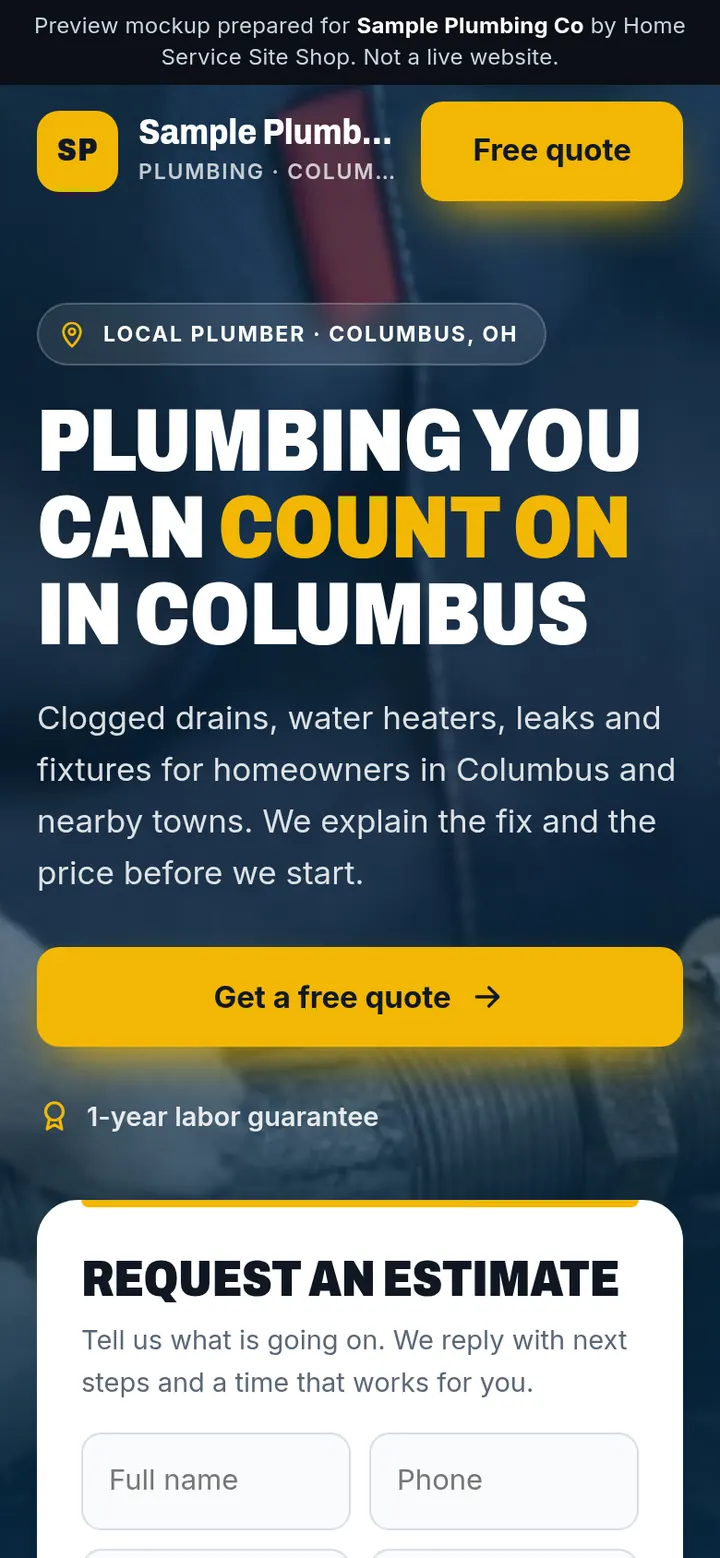
What a plumbing website looks like on a phone
This is our plumbing template shown with a made-up company. Look at the first screen: the problems the shop fixes, the area it covers, and a large button to get in touch. That is all most people calling a plumber need to see before they decide.
On your build, we swap in your company name, logo, phone number, towns, services, and photos of your own trucks and crew. If you do not have a logo yet, the ~50-page and ~100-page plans include a mascot/logo, or you can get a custom logo for $99 on its own.
Sample business, sample text. This is a template demo, not a client website.
Websites vs. bought leads
A plumber website vs. paying for leads
Lead companies and pay-per-call services can fill a slow week. The catch is that you pay for every lead, many are shared with other plumbers, and when you stop paying, the calls stop. Your own website works differently: you pay for the build and $49/mo maintenance and unlimited updates, and there are no per-lead fees on the calls it brings.
It is not either/or. Plenty of plumbers buy some leads while their own site and Google profile build up, then lean on them less over time. A website takes longer to pay off than a bought lead, and that is the honest trade-off. If you are weighing it up, these guides use published prices and real math:
- What plumbing leads really cost (2026): shared vs. exclusive leads, Google Local Services Ads, and cost per booked job
- Plumbing lead companies compared (2026): prices, contracts, and who owns the website
- How to get more plumbing calls: the free things that bring calls, written by a plumber
- How much a plumber website costs: our published prices and five questions to ask any web designer
How it works
Four steps to a working site
Choose a package
Pick a plan and pay through Stripe checkout.
Share your details
Share your services and towns — drains, water heaters, tankless, emergency calls, whatever you offer.
We build the site
Plain, crawlable WordPress pages that work on phones.
Launch, then maintain
Your site goes live, and $49/mo covers maintenance and unlimited updates to keep it current.
More for trade businesses: all trades we build for · HVAC websites · contractor websites · construction company websites · electrician websites · roofing websites · website cost vs. Wix or Squarespace
FAQ
Straight answers for plumbers
Do you do plumbing work?
No. Home Service Site Shop builds websites for plumbers. You handle the drains, heaters, and jobs.
How much does a plumber website cost?
Our prices are published: $0 upfront for a one-page site, $299 for a 5–8 page Starter site, $1,695 for a ~50-page full site, or $2,575 for a ~100-page site. Every plan is $49/mo maintenance and unlimited updates. See the plumber website cost guide for what changes the price.
What is the monthly fee?
Every monthly fee is $49/mo for maintenance and unlimited updates, including the ~100-page package. Details on pricing.
What pages should a plumbing website have?
At minimum: a home page, a page for each main service (drain cleaning, water heaters, leaks, sewer), a service-area page, and contact. Bigger shops add tankless, repiping, emergency, and one page per town they serve.
Will my phone number be on every page?
Yes. Every site we build shows your own phone number on every page, set up for tap-to-call on phones, plus a short quote form for people who would rather type.
Do you build websites for drain cleaning and rooter companies?
Yes. Drain, rooter, and sewer shops get pages for drain cleaning, main line backups, hydro jetting, and camera inspections, plus the towns they cover.
Can I start with one page?
Yes. The free one-page website is $49/mo maintenance and unlimited updates. Add more pages when you are ready.
Is a website better than buying plumbing leads?
They do different jobs. Bought leads cost money every time; your own site has no per-lead fees but takes longer to pay off. Many plumbers use both. Our plumbing leads cost guide shows the math.
Do you work with HVAC too?
Yes. See HVAC website design.
Get a plumber website that brings you calls
A page for every job you do. Your number on every page. Plain prices.
Questions? tradekitco13@gmail.com